
The long-awaited HUMAN 81 DK is now available.
Best viewed in "landscape" mode.
Driver Information
|
The following concave aluminum dome tweeters
are all identical in performance, they differ only in mounting arrangements. | |
| PRO 002 M | 3 1/2" diameter round |
| PRO 002 M2 | 4" diameter round |
| PRO 002 MP | 4 1/2" by 3 1/8" (upgrade Peerless) |
| PRO 002 MA1 | 5" by 4 3/8" (upgrade large Advent) |
| PRO 002 MAP | 4 3/4" by 3 1/2" (upgrade Advent Prodigy) |
| PRO 002 ME22 | 5 3/8" diameter round (upgrade Energy 22) |
| PRO 002 MBUR | 4 3/4" by 4" (upgrade Burhoe Acoustics) |
| PRO 002 ME1 | 5" diameter round (upgrade EPI) |
| PRO 002 ME2 | 4 3/4" by 3 1/4" |
| PRO 002 ME3 | 5" semi-circle top mount |
| PRO 002 ME4 | 4 3/16" diameter round |
| PRO 002 ME5 | 3 5/8" by 3 3/8" |
| PRO 002 MG | 4 7/8" by 4 7/8" (upgrade Genesis Physics) |
| PRO 002 MX | Built to your custom dimensions |
| Six inch woofers. Very nice. | |
| PRO 007 | 6" long throw woofer |
| PRO 008 | 6" 2 ohm long throw woofer |
| Eight inch woofers. Spectacular. | |
| PRO 001 | 8" long throw woofer |
| PRO 005 | 8" extra long throw woofer |
| PRO 006 | 8" 2 ohm long throw woofer |
| Ten inch woofer. Marvellous. | |
| PRO 031 | 10" long throw woofer |
| Passive radiators. | |
| PRO 049 | 8" passive radiator |
| PRO 014 | 10" passive radiator |
| I also sell a couple of midranges. | |
| PRO 024 | This is a wide-range driver that is also a very good midrange |
| PRO 027 | 6" open-back midrange with very smooth response |
There are a number of Kit and Driver Options available.
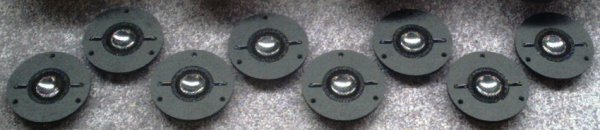
The tweeters I build are a direct descendant of the classic EPI "airspring" tweeter designed in the late sixties by Winslow Burhoe. Over the years it has been improved, from the introduction of Ferrofluid™ magnetic cooling liquid, to better dome materials, through its use and further development at Genesis Physics, where the aluminum dome version that I have refined was first introduced.
I build the tweeter in a variety of formats, from several diameters of round faceplates to a few curved- or sharp-cornered rectangles and squares. It is also possible for me to make very small quantities of tweeters using a faceplate made to your specifications.
This tweeter is a remarkable machine. The carefully designed magnet structure is the launching pad for an overlength, highly linear voice coil.
The concave dome allows a smaller diameter voice coil which is then better coupled to any given point on the dome. This concave shape also produces an almost perfect waveform (its main strength), reproducing the original signal with an accuracy that a convex dome never can. This accurate sound is also dispersed widely (its second main strength), down only a few dB at the highest frequencies even at 180 degrees off-axis.
The electrical and physical resonances are both well below 1300 Hz, with a smooth frequency response starting around 1600 Hz and extending to 26 kHz. The distortion level is at or below 0.1% when driven with less than ten watts above 2.5 kHz. This gives a sweet, open, uncolored sound that you can really listen into.
The power handling capacity of the tweeter itself is roughly 25 (clean) watts above its crossover frequency. Remember that the tweeter sees only a small percentage of the total system power. They can comfortably be used in two way systems running up to 200 watts per channel.
With a 10% duty cycle I've seen it take 1000 (very, very clean) watts at about 3 kHz. In spite of having six inches of sound absorbing material held over the face, it was like having a hammer hitting an anvil in the room with us.

The woofers are descended from those in the original EPI 100 and 50 models, which were accorded great esteem when they were new, and still earn the almost reverent respect of their owners to this day. They have small diameter cones to provide good dispersion and transient response, and very low resonances and long excursions for serious bass reproduction.
I build both six, eight, and ten inch woofers. The "standard" long throw voice coil, as used in the PRO 001 and the PRO 007, has 3/4" of winding in a gap that is 1/4" tall. The PRO 005 8" has an even longer voice coil. Both two ohm woofers have 3/4" long voice coil windings, and are useful for speaker designs that require two drivers (placed in series for a reasonable amplifier load).
These woofers are best used in sealed boxes - I think it gives the most pleasing overall response - but they are unique, even a bit odd, in that most of them also perform very well in properly aligned vented systems. The PRO 001, for instance, works well in a sealed box from less than a cubic foot up to two and a half cubic feet, but can also be combined with the PRO 015 passive radiator in a 1.8 cubic foot box. The commercial viability of this design was demonstrated very well by the Genesis 2 and 2+.
Whether you build one of the suggested designs, taking advantage of these drivers' naturally complementary design, or work with one (or more) that you like in a system of your own concoction, I am sure you will enjoy their ease of use and elegant lack of coloration.
The woofers all feature butyl rubber surrounds and treated cones to minimize air leakage; the surrounds also far outperform polyether foam in longevity.
I build three sizes of passive radiator, which I make available to the experimenter who desires to build a vented system without the problems associated with port tubes.
The dimensions and specifications of each part are listed in their individual files.
These specifications were measured from batches of at least ten of the component in question.
They were broken in with a signal consisting of a varying sine wave sweeping over most of the drivers usable frequency range, at a level creating an excursion of at least 10% of Xmax at some point, for at least 20 hours.
The woofers were measured hanging in open space by a small chain hooked to one of their mounting holes. Tweeter measurements were made with them lying on their back in a flush baffle, on a thick wooden bench about 8 feet from the ceiling.
* * *
Top - Contact
New Speakers -
EPI and Epicure - Genesis Physics
© Copyright - All Rights Reserved

Seven Kelsey Road, Lee, New Hampshire 03861
Prices can change and specifications will improve without notice